Pre-purchase guide
Buying a riad to renovate in Marrakech: what to check before you sign
Legal status, structure, services, access and permits: what to check before you sign.
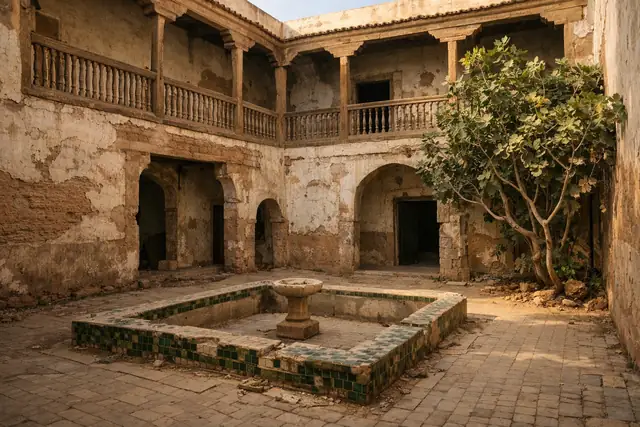
A riad "to renovate" is cheaper than a restored one, but the asking price tells you almost nothing about the final bill. Two houses listed at the same price can need works that differ by a factor of three, depending on the walls, the roof terraces and the services. This page lists what to look at before you sign, from the point of view of the people who then design and run the renovation.
Simple rule: never buy a riad to renovate without a costed idea of the works.
1. Legal status: titled or melkia
This is the first filter, before any technical visit. A titled riad (titré) is registered with the Land Registry (Conservation foncière): its area, boundaries and owners are on record. A melkia property rests on a traditional notarial deed, often with many heirs, and regularising it can take time. Have the status, the list of owners and any easements checked by a notary or lawyer who is independent of the seller. That is not our trade, but it conditions everything else: nobody should start a renovation on a property whose ownership can be challenged.
2. The structure: where the real money goes
In the medina, many riads are built in rammed earth (pisé) or solid brick, with timber floors. These materials last well as long as they stay dry. What to check on site:
- Walls: through-cracks, bulges, render that sounds hollow, crumbling wall bases.
- Roof terraces: water gets in from the top. Look for stains under ceilings, ask whether the waterproofing has been redone, check the drains.
- Floors and beams: visible sagging, damaged timber, floors that bounce.
- Damp: rising damp at the foot of walls, a musty smell, salt deposits. In winter you see it; in summer it hides.
- Party walls: a riad shares its walls with its neighbours. The state of the house next door matters as much as yours.
If the building looks fragile, bring in an architect or a structural engineer before committing: they will tell you whether the structure can be consolidated or has to be rebuilt, and that difference changes the order of magnitude of the budget.
3. Services and comfort
Electricity, water and drainage almost always need to be redone entirely in an old riad. Check the water and power connections, the available electrical capacity, the connection to the sewer and the state of any septic tank. For a rental or guesthouse, think now about how many bathrooms the layout can take: each extra bathroom needs space, drainage and ventilation.
4. Access and site logistics
A riad at the end of a 1.2-metre derb is not renovated like a house you can reach by van. Find the nearest medina gate, the walking distance, the steps, the width of the front door. Every material arrives by hand or by cart, which weighs on both the schedule and the structural budget. Our riad renovation cost guide accounts for this item by item.
5. Permits
Any change to the structure, façade or volume requires authorisation from the municipality, and the Marrakech medina is a protected area where some works are restricted. Before buying on the assumption of an extra storey, a plunge pool or a new roof terrace, find out what can actually be authorised at that address. A project built on an unchecked assumption is the surest way to lose money.
6. The project before the price
The right riad depends on what you want to do with it: second home, guesthouse, short-term rental. Number of possible bedrooms, light in the courtyard, a usable roof terrace, a quiet derb: these drive the value of the house far more than a few extra square metres. If the riad is meant to be rented, see also our Airbnb interior design in Marrakech page.
Next: budgeting the renovation
Once the property is secured, the renovation follows three stages: survey, design with line-by-line costing, then a managed build. Ranges per renovation level and per item are published in our riad renovation cost guide. The full process, including when you live abroad, is described on our riad interior design and renovation and online interior design pages. New to the building type? Start with what a riad is and how it is laid out.
Frequently asked questions
Is it better to buy a renovated riad or one to renovate?
A renovated riad costs more to buy but can be lived in or let straight away; you also inherit the previous owner's choices, and sometimes hidden defects. A riad to renovate lets you design the house around your use, at the cost of a building phase lasting several months. Either way, have the roof terraces, damp and services inspected before you sign.
What does a "titled" riad mean?
That it is registered with the Land Registry, with a title stating its area, boundaries and owners. It is the safest position for a buyer. An untitled (melkia) property is not necessarily one to avoid, but its regularisation must be checked by a legal professional.
How long does a riad renovation take?
It depends on the condition of the building and on the permits required. Typical timelines are given in the FAQ of our riad renovation in Marrakech page.
Can you help us assess a riad before buying?
Show us the property during the free 30-minute discovery call: listing, photos, plans if you have them. We will tell you what should be checked and how the project would be structured. Legal checks remain a matter for a notary or lawyer, and structural questions for an architect.