The working guide
Moroccan interior design: the working guide from a Marrakech studio
Courtyards, natural light and craft materials: Moroccan style without the souvenir-shop clichés.
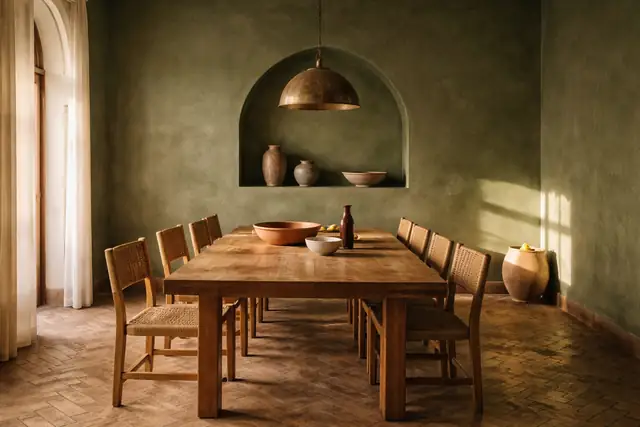
Most articles about Moroccan interior design are written from a Pinterest board. This one is written from Marrakech, by a studio that commissions the zellige, argues with the tadelakt master and lives with the results. Here is what the style actually is, what it costs, and how to get it right: whether you are decorating a riad in the medina or bringing the look into a house in London or Los Angeles.
What is Moroccan style interior design?
Moroccan interior design is architecture-led, not object-led. Its foundations:
- Inward-looking space: the traditional Moroccan house (the riad) turns its back on the street and opens onto a central courtyard. Light falls from above; rooms are calm and shaded.
- Craft materials as the decor: tadelakt (polished lime plaster), zellige (hand-cut glazed tiles), bejmat (terracotta brick floors), carved cedar, sculpted plaster (gebs), brass and wool. The surfaces are the ornament: a great Moroccan room can hold almost no "decoration" at all.
- Geometry and repetition: Islamic art avoids figurative motifs; pattern comes from mathematics: stars, crosses, interlacing: repeated at every scale from a tile to a ceiling.
- Low, communal comfort: banquettes along walls, low tables, floor cushions. The room is built for conversation, not for a television.
Done well, the style is restrained and tactile. Done badly, it is a heap of lanterns and poufs: the souvenir-shop version. The difference is editing.
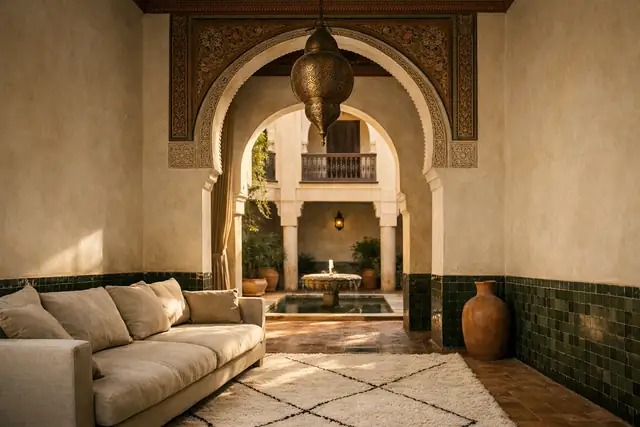
The colours of Moroccan decor
The palette comes from materials and landscape, not from a paint chart:
| Colour family | Source | Use it for |
|---|---|---|
| Warm whites and sand | Limewash, plaster | Walls, ceilings: the backdrop, 70% of the room |
| Terracotta, ochre, rust | Clay, bejmat, the city of Marrakech itself | Floors, one feature wall, textiles |
| Majorelle blue | The Majorelle Garden | One accent, used sparingly: a door, planters |
| Emerald and Tamegroute green | Glazed pottery of the Draa valley | Zellige, ceramics, one bathroom |
| Deep reds and burgundy | Berber rugs, leather | Rugs and cushions, never full walls |
| Brass and aged gold | Lanterns, trays, taps | Lighting and hardware, the room's jewellery |
Rule from our projects: two or three families per room, one dominant, backdrop always calm.
Room by room: modern Moroccan interior design
Moroccan living room
Anchor with a vintage Berber rug (Beni Ourain or Azilal), build seating low and generous, then add a single strong craft element: a tadelakt fireplace or a carved ceiling. Contemporary sofas work perfectly next to hand-made surfaces; that contrast IS modern Moroccan style.
Moroccan bedroom
Keep it almost monastic: limewashed walls, one textile headboard or a wool hanging, a pair of brass sconces. The luxury is in the materials, not in the quantity of objects.
Moroccan bathroom
The strongest room for the style: tadelakt walls (waterproof by nature, no tiles, no joints), a zellige vanity splash, brass taps. See how we approach it, property type by property type, in what we do.
Kitchen
Zellige splashback, cedar or painted joinery, terracotta floors. Keep appliances invisible; the craft surfaces do the talking.
Courtyard and terrace
If you have one, it is the main room. Plants (citrus, jasmine), a water feature however small, floor cushions and low tables. In Marrakech we design the courtyard first: see our riad interior design service.
Getting the look outside Morocco
Three honest tips from a studio that ships worldwide:
- Buy fewer, better pieces: one genuine hand-cut zellige panel beats thirty machine-made "Moroccan-style" tiles. Same for rugs: vintage wool, not printed polyester.
- Respect the backdrop rule: white or sand walls, natural floors. The style dies in rooms already saturated with colour.
- Mix eras deliberately: Moroccan craft next to mid-century or contemporary pieces reads as sophisticated; total-look Moroccan reads as a restaurant.
Our online Moroccan interior design service handles exactly this: moodboards, sourcing from Marrakech workshops, and shipping coordination, wherever you live. For a full property in Morocco, start with villa interior design in Marrakech.
Frequently asked questions
What is Moroccan style interior design?
An architecture-led style built around courtyards, zenithal light and craft materials: tadelakt, zellige, cedar, brass, wool: with geometric pattern and low, communal seating. Its modern version pairs those hand-made surfaces with restrained contemporary furniture.
What are the colors of Moroccan decor?
Warm whites and sand as the backdrop; terracotta and ochre from clay and bejmat; accents of Majorelle blue, Tamegroute green, Berber-rug reds; brass as the metallic. Two to three families per room, backdrop always calm.
What is the 3-5-7 rule in interior design?
Group decorative objects in odd numbers: threes, fives, sevens: because asymmetry reads as natural and keeps the eye moving. It suits Moroccan interiors well: cluster three ceramics or five lanterns rather than symmetrical pairs.
Which designer lived in Marrakech?
Yves Saint Laurent is the most famous: he owned the Majorelle Garden with Pierre Bergé. American designer Bill Willis lived and worked in Marrakech for decades and shaped the modern riad aesthetic (he popularised tadelakt beyond the hammam); Jacques Grange and Jasper Conran have also kept homes here.
What defines the Moroccan style?
The primacy of craft: surfaces made by hand (plaster, tile, wood, metal), geometry instead of figurative ornament, inward-facing rooms organised around light and water, and furniture built for gathering. Objects are secondary; materials are the style.